

EV BATTERY WASTE AND RECYCLING PATHWAYS: UNDERSTANDING THE FATE OF USED EV BATTERIES?
By: Jessica Hanafi, PhD (KOLEKSI 911)
Carshe adoption of Battery-Based Electric Motor Vehicles (KBLBB) or Electric Vehicles (EVs) has accelerated significantly globally and nationally. With incentives from the government and the rapid expansion of the EV manufacturing industry, the EV market in Indonesia is projected to grow 26-fold from USD 7 billion in 2023 to USD 182 billion in 2030, based on a study conducted by UN PAGE in 2025.
Behind the benefits of reducing greenhouse gas emissions in the use phase, this transition brings new challenges downstream of the supply chain. Each unit of electric car carries an average battery pack weighing 300 to 500 kilograms. As the Electric Vehicle (EV) population soars, a crucial question arises: "What will be the fate of the hundreds of thousands of tons of batteries when their useful life is over?"
The massive size of EV batteries presents much more complex management challenges than conventional consumer batteries. In the European Union, the downstream system of conventional battery management has been built through the Extended Producer Responsibility (EPR) scheme since 2006 through the provision of free drop-boxes in the retail sector. However, it took 17 years for the advanced region of Europe to finally pass a special regulation for EV batteries in 2023, with the achievement of battery recycling that has been fully covered even though the collection of lithium batteries for gadgets is still being optimized[1].[2]
What about Indonesia?
Managing different types of battery waste in Indonesia presents a diverse reality, from direct disposal to industrial recycling. Household batteries such as alkali and zinc-carbon mostly end up in open landfills (landfills) with no economic value for scavengers, although a small percentage is starting to be managed through community dropboxes and waste banks. Meanwhile, small lithium-ion batteries from gadgets often go through informal channels such as repair centers and scrap collectors, and some valuable materials are exported abroad because domestic refining facilities are limited.
Lead-acid batteries (batteries) have a collection rate of almost 100% due to the high economic value of lead, although most of them still enter the informal smelting sector, which is a high risk to the environment. In contrast, solar system batteries (PLTS) in remote areas are often abandoned or cannibalized locally because transporting B3 waste is costly.
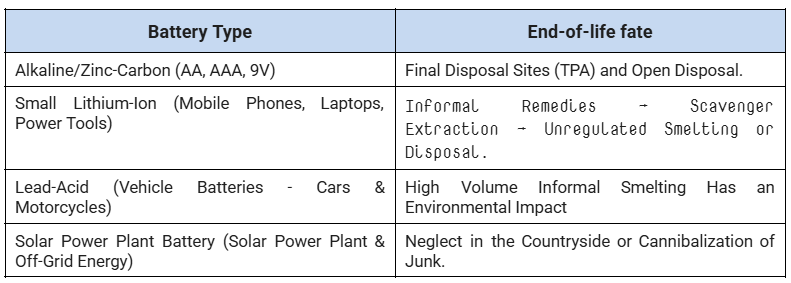
Waste battery management in Indonesia faces systemic challenges due to strict B3 waste regulations (PP No. 22/2021) that limit the number of licensed authorized recyclers, the absence of a national Extended Producer Responsibility (EPR) scheme to fund collection boxes at the retail level, and the dominance of the informal sector that only hunts for high-value waste. As a result, lead-acid batteries (batteries) are massively collected due to high lead prices in the second-hand market, while portable batteries such as disposable alkaline batteries that have no economic value end up being neglected in domestic landfills.
Looking at battery handling in Indonesia today, what is the fate of used EV batteries?
The fact that it took the European Union 17 years to mature EV battery regulations is a loud alarm for Indonesia. With conventional battery waste management systems still uneven and dominated by the informal sector, the surge in EV adoption risks becoming a new environmental crisis if not anticipated early. Used batteries should not be seen simply as hazardous waste, but as "urban mining" rich in critical materials. Proper end-of-life (EoL) management will determine whether this electric mobility transition truly creates a circular green economy or instead shifts the burden of pollution from the air to the ground and water.
Understanding EV Battery Waste: When Does It Become "Waste"?
In the electric vehicle industry, declining battery performance does not necessarily make a battery waste. EV batteries technically enter the automotive End-of-Life (EoL) stage when their health condition (State of Health/SoH) drops to 70% to 80%. Based on a UNIDO and PAGE (2025) study, Impact Assessment of EV Adoption in Industry, this threshold is generally reached after 3 to 10 years of use, depending on the vehicle's charging pattern and operational load.
At this SoH level, the reduced acceleration and cruising range make it no longer optimal for mobility needs. However, this battery is actually not yet waste. With its remaining capacity still substantial, this battery module is in a transition phase and is well suited for repurposing into a stationary energy storage system (second-life storage).
New EV batteries can become solid waste that must be specially treated when cell capacity and stability have degraded—generally below 40% SoH—making them no longer economical or safe for storage.
Used Battery Management Hierarchy: Three Main Paths
To prevent batteries from degrading into environmental burdens at the Final Processing Site (TPA) while maximizing their mineral value (such as lithium, nickel, and cobalt), the transition of used batteries is managed through a circular economy hierarchy divided into three pathways (The 3 Pathways):
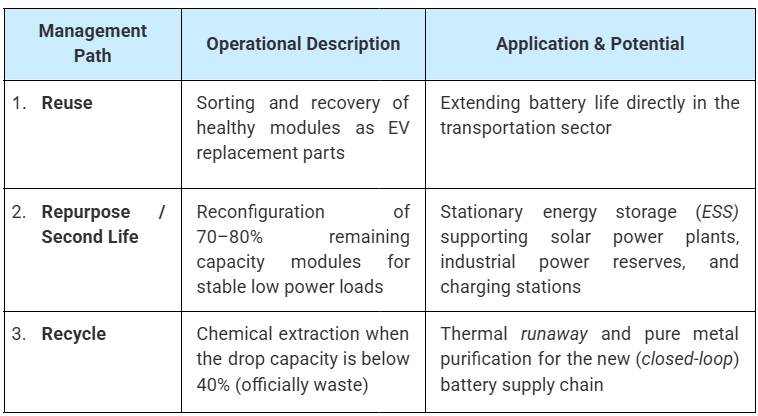
Second-lifebatteries (Second-Life Batteries / SLBs) are a crucial bridge that delays the need for recycling while extending asset lifecycles for years to come. Pilot global projects such as the RWE and Audi collaboration that consolidated used Audi e-tron batteries into 4.5 MWh stationary ESS units are one example of the technical feasibility of this scheme[3].
In Indonesia, SLBs have dual strategic value: delaying the burden of generating national B3 battery waste while providing affordable power storage to stabilize solar PV in remote areas (3T). However, when the battery's SoH finally drops below 40% and is no longer stable, it reaches its utilization limit and officially enters the final stage of recycling.
Recycling Technology Comparison: Remaining Critical Materials
To reclaim these critical minerals, the global recycling industry currently relies on two main commercial methods:
Pyrometallurgy is a high-temperature, energy-intensive thermal process that makes it difficult to recover lithium.
Hydrometallurgy is a wet chemical process that recovers metals with high purity (>95%).
Beyond these two technologies, other innovations to develop more efficient, low-emission direct recycling processes are still underway.
The Regulatory Landscape and Industrial Reality in Indonesia
The commitment to EV battery circularity in Indonesia is reflected in the B3 waste regulation (Government Regulation No. 22/2021 and the Minister of Environment and Forestry Regulation No. 6/2021), the Bappenas circular economy action plan 2025–2045, as well as the tightening of the 60% TKDN requirement that encourages the construction of domestic recycling facilities. However, the lack of a structured collection scheme and binding Extended Producer Responsibility (EPR) regulations remains a critical gap that risks pushing used batteries into the informal smelting sector.
Strategic Recommendations and Closing
In order for the electric mobility transition not to shift exhaust emissions into a B3 waste crisis in soil and water, three synergistic steps are needed:
EPR Regulation for EVs (Short Term 2026–2029): Require a take-back mandate for manufacturers through an official workshop network as a formal gathering point (Coordination of Environment and Forestry and the Ministry of Industry).
Second-Life & BaaS (Medium-Term) Standardization: Issue a used battery feasibility test protocol for ESS/PV and adopt a Battery-as-a-Service model to maintain asset ownership (BSN) traceability.
Recycling & Design for Recycling Incentive (Long-Term): Provide fiscal incentives for domestic hydrometallurgical facilities and encourage modular battery designs that are easy to dismantle.
The transition to electric vehicles isn't complete until the last battery is recycled safely and efficiently. A true green transition must be circular: not just replacing fossil fuels on the roads, but ensuring every critical mineral atom remains in rotation to add value in the national economic chain.
Related Articles

27 Oct 2026
EV Batteries and Safety Challenges: From Maintenance to Thermal Runaway
By: Prof. rer.nat. Evvy Kartini (KOLEKSI 910)
27 Oct 2026
BUKAN EMP, INI PENYEBAB MABUK DI MOBIL LISTRIK
By: Hendro Sutono (KOLEKSI 913)
27 Oct 2026
5 HAL YANG DITAKUTKAN ORANG SEBELUM MEMBELI MOBIL LISTRIK
By: Luki Cahyadi (KOLEKSI 14)